
Ever wonder why some websites attract a steady stream of traffic while others barely get noticed? The difference often lies in how well they understand and implement keyword research. Keyword research is the backbone of any successful SEO strategy, iit helps you understand what your audience is searching for and how to create content that meets their needs. In this guide, we’ll break down the first steps to keyword research in a simple, actionable way.
Table of Contents
What is Keyword Research and Why Does It Matter?
Keyword research is the process of identifying the words and phrases people use when they search online for information, products, or services related to your business. It’s not just about finding popular search terms, it’s about discovering opportunities to connect with your audience through valuable content.
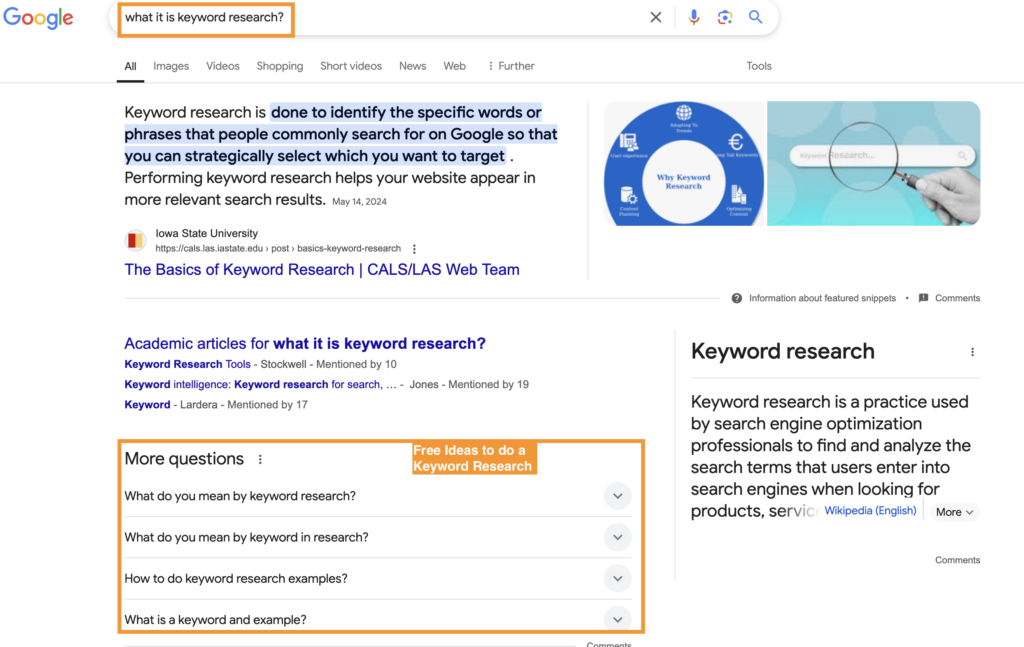
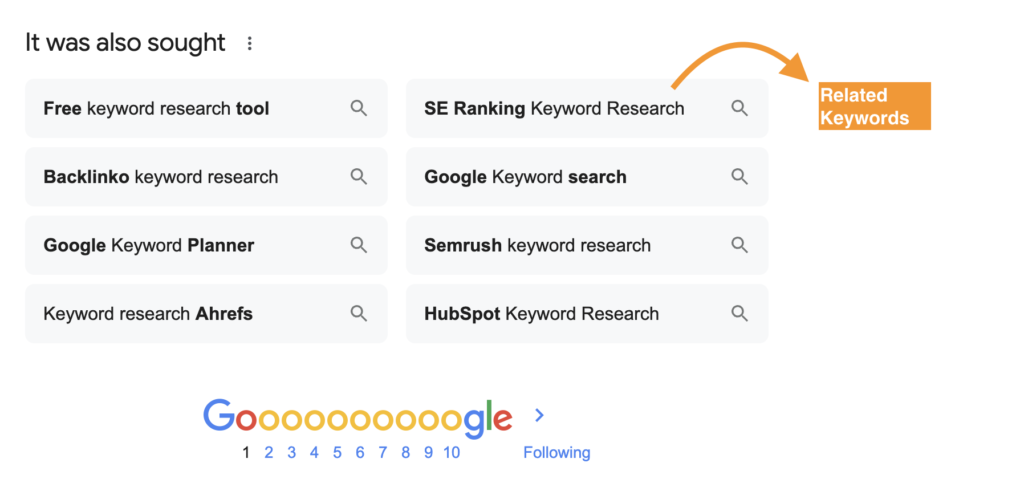
When done correctly, keyword research helps your content rank higher in search engines like Google, leading to more organic traffic, better engagement, and increased conversions. Without it, you risk creating content that no one is looking for.
Step 1: Define Your SEO Goals
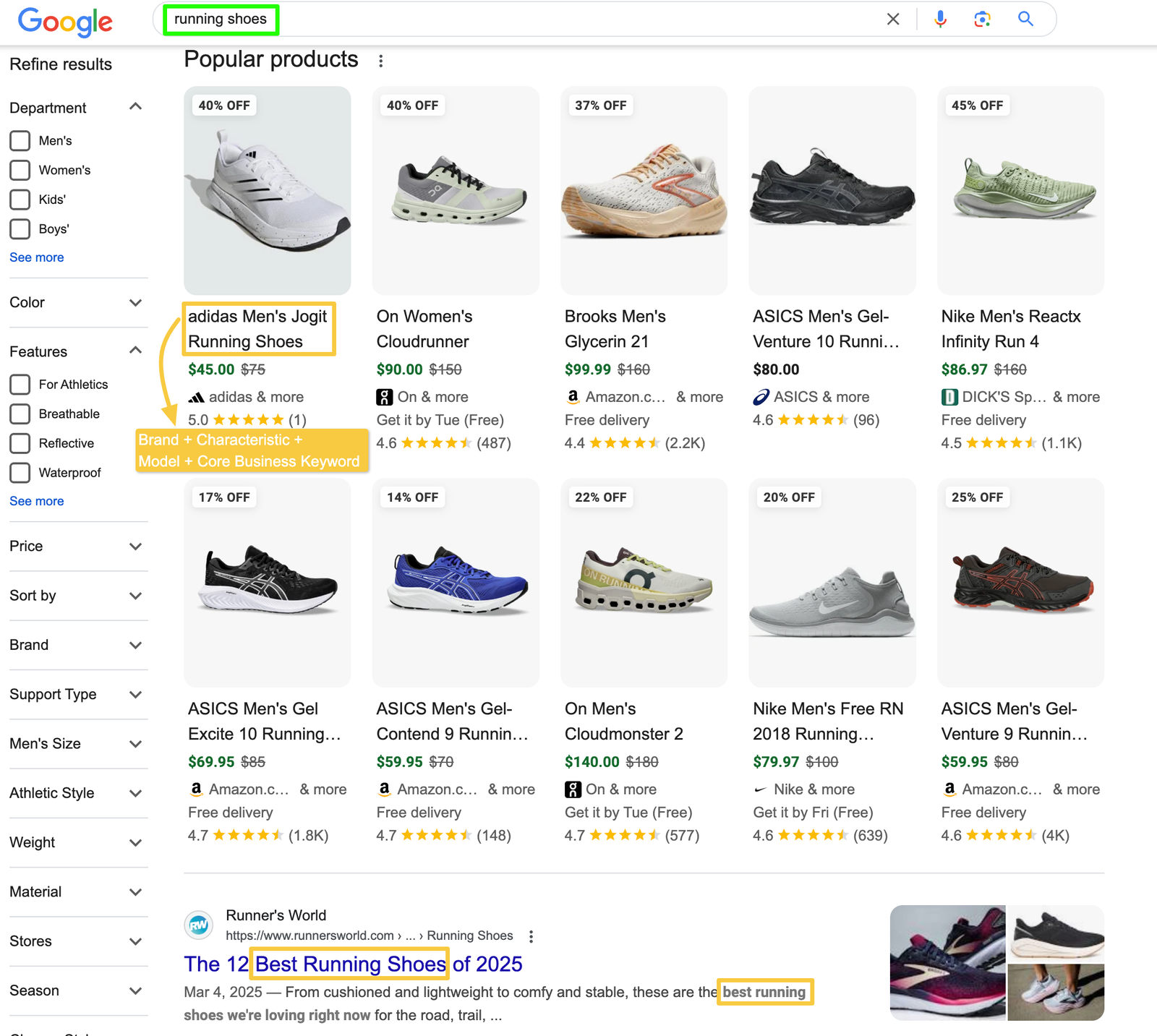
Before diving into any tool or data, clarify what you want to achieve with yout SEO strategy. Are you looking to boost brand visibility, generate leads, or drive sales? Your goals (the understanding of your industry) will influence the type of keywords you focus on: informational, commercial, or transactional. As well as, tells you what your audience is really looking for. Let’s go with an easy example:
In this image we can see for the term “running shoes”, the original search intent should be transactional due to in this case Google understand people are looking 👀 to buy a pair of shoes.
Step 2: Start with Core Business Keywords
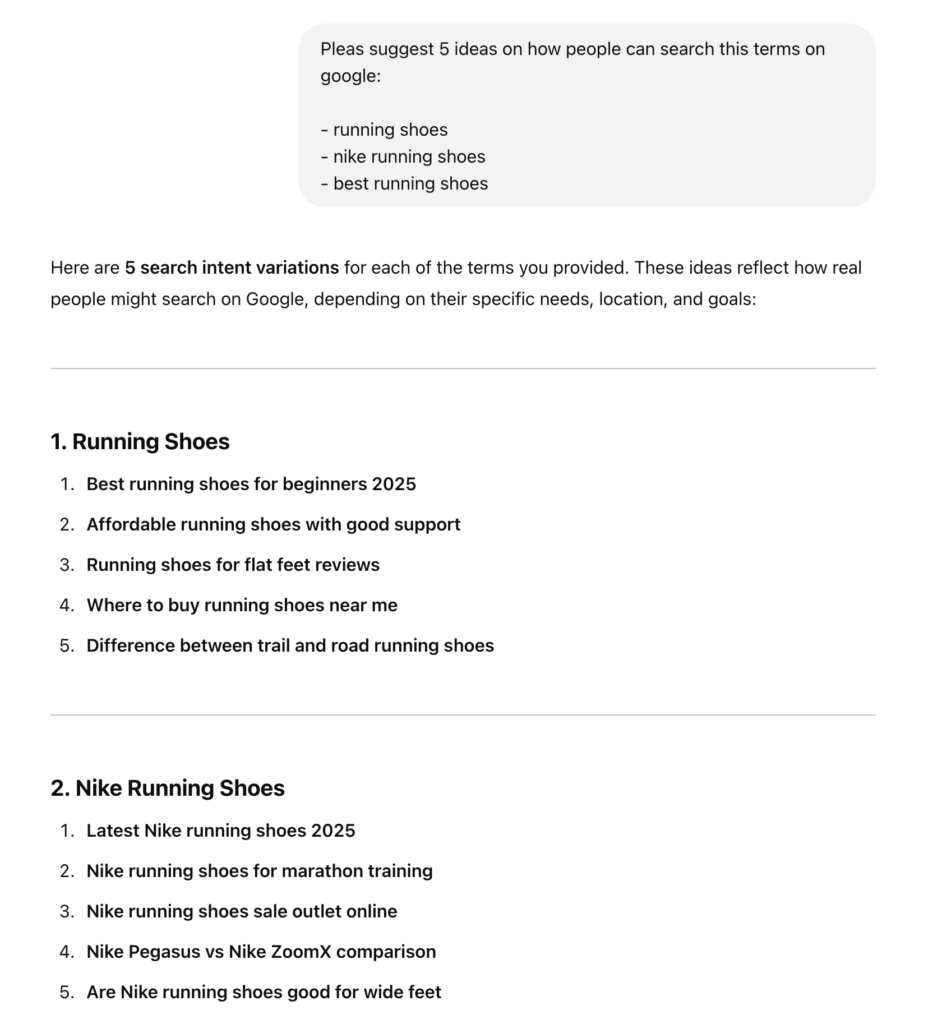
Core Business keywords are the foundation of your research. These are basic terms related to your industry. For example, if you run a fitness blog, core keywords might include “workout routines,” “nutrition tips,” or “weight loss plans.” Think about what your audience might type into Google and list out these initial ideas.
💡 Pro Tip: If you run out of ideas, let’s Chat GPT give you a hand.
Step 3: Expand Using Keyword Tools
Once you have your seed keywords, use keyword research tools to find variations, related terms, and data on search volume and difficulty. Popular tools include Ahrefs, Semrush and Google Keyword Planner. Ahrefs is known for its backlink data and keyword suggestions, while SEMrush offers comprehensive competitor analysis. If you’re on a budget, Google Keyword Planner is a solid free option, as well as Google Trends and Answer the Public.
🚨 Coming soon: A Complete Guide to do a Keyword Research with FREE Tools.
Step 4: Check Out Your Competitors
Spy on your competition. Tools like Semrush let you see which keywords your competitors rank for. This can reveal gaps in your own content and inspire new keyword ideas you hadn’t considered.

Understanding the Anatomy of a Keyword to Choose Them
Step 5: Understand Search Intent
Not all keywords are created equal. To rank effectively, you must understand the intent behind a search. There are four main types of search intent:
- Informational: The user wants to learn something (e.g., “how to lose weight fast”).
- Navigational: The user wants to visit a specific site (e.g., “Nike website”).
- Transactional: The user is ready to buy (e.g., “buy running shoes online”).
- Commercial Investigation: The user is comparing options (e.g., “best running shoes 2025”).
“Matching your content” to the right intent ensures you attract visitors who are more likely to engage and convert.
Step 6: Understanding the length potential of the keyword
A commom mistake is normally businesses try to rank for the business keyword, for example an e-commerce that sells running equipment, let’s imagine they sell products related with the NIKE brans, so more likely they want to rank for ⭢ “nike shoes”, but in this case I am pretty sure it will be the own nike.com page that will be capable to rank for this head tail keyword.
So how can an e-commerce site still tap into that traffic opportunity and rank for terms related to “nike shoes”? First, you need to understand these 3 key points:
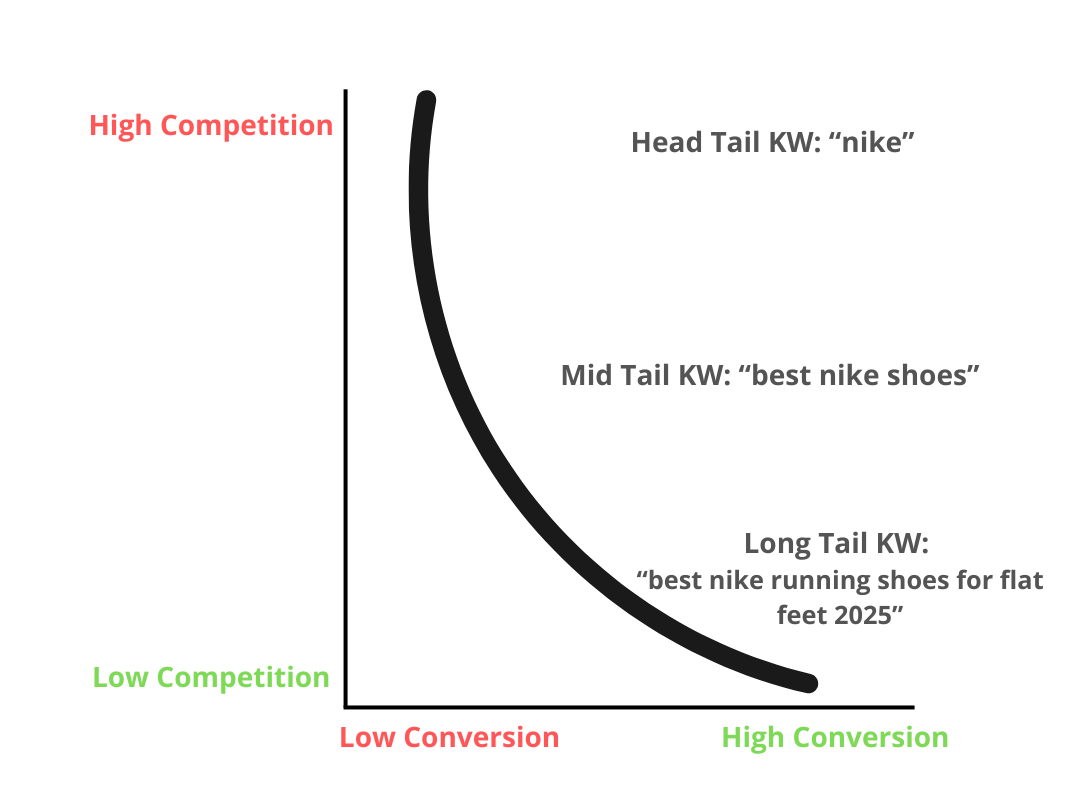
- Head-Tail Keywords: These are very broad, one or two-word terms with massive search volume and competition. Examples include “shoes,” “nike,” or “running.” While they attract a lot of traffic, they are too general and often lack clear search intent. Ranking for them requires huge domain authority.
- Mid-tail keywords: are slightly longer phrases, typically 2-3 words, with moderate search volume and competition. They are more specific than head terms and reflect clearer intent. For example, “nike running shoes” or “best nike shoes.” These are more realistic targets for growing websites and offer better engagement than head terms.
- Long-tail keywords are very specific, often more than 4 words that focus on niche audiences or specific needs. For instance, “best nike running shoes for flat feet 2025.” These keywords have lower competition and higher conversion rates because the user is further along the buying journey and knows exactly what they want.
Step 7: Analyze Keyword Metrics
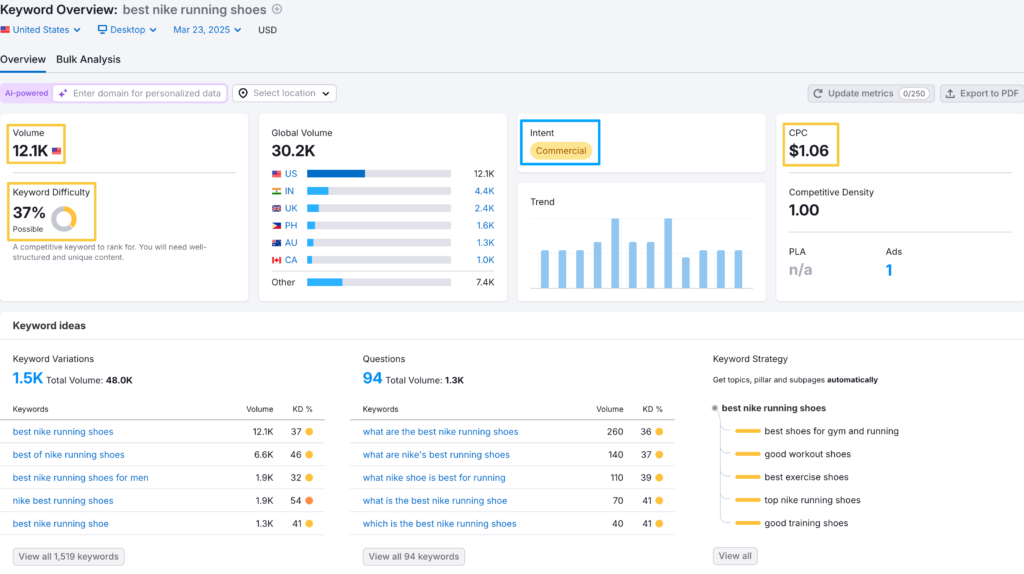
Not every keyword is worth your time and effort. Some may be too competitive, too broad, or simply not relevant enough to drive meaningful traffic. That’s why it’s essential to evaluate key metrics before deciding which keywords to target. I personally, use Semrush tool so we will be looking at that interface, here are the three most important ones to understand:
Search Volume
This tells you how many times a keyword is searched each month. High search volume often means more traffic potential, but it can also indicate higher competition. For example, a keyword with 10,000+ searches per month might seem attractive, but unless your site has strong authority, it can be very difficult to rank for.
Keyword Difficulty (KD)
This metric estimates how hard it will be to rank in the top positions for a specific keyword. Tools like Ahrefs and Semrush provide a keyword difficulty score (usually from 0 to 100). The higher the score, the tougher the competition. As a beginner or growing site, it’s often smarter to focus on low to medium difficulty keywords, where you have a realistic chance to rank and gain traction.
Cost-per-Click (CPC)
This metric shows how much advertisers are willing to pay for a click on that keyword in paid search ads. While CPC is primarily used in paid advertising, it also reveals how valuable a keyword is commercially. A higher CPC often signals buyer intent, meaning people searching for that keyword are more likely to convert. Even if you’re not running ads, it’s a useful indicator of a keyword’s business potential.
Balance high-volume keywords with lower competition opportunities. For instance, “SEO” is extremely competitive, while “SEO tips for small businesses” is more niche and achievable.
By focusing on mid-tail and long-tail keywords, we can attract more qualified traffic, compete realistically, and drive better conversions. Over time, ranking for these specific terms can also help build authority, making it easier to target more competitive keywords in the future.
Put into Action your Keyword Research
Step 8: Prioritize and Plan
You now have a list of potential keywords. Prioritize them based on relevance to your goals, search intent, and difficulty. Create a content calendar that targets these keywords strategically. Start with easier wins, then tackle more competitive terms as your domain authority grows.
Step 9: Create Optimized Content
Use your keywords naturally in the title tag, URL, headings (H1, H2, H3), and throughout the content. Don’t overdo it, focus on delivering value. Google rewards content that satisfies the user’s intent, not content stuffed with keywords.
Read the following post if you want to know more about SEO Content Basics.
Step 10: Monitor and Refine
Keyword research isn’t a one-time task. Use tools like Google Analytics and Google Search Console to track how your content is performing. Update older posts, optimize underperforming pages, and adapt to shifts in search behavior.
How Boost SEO with Alba Can Help You Succeed
Keyword research can be overwhelming, especially when you’re juggling a growing business. That’s where Boost SEO with Alba comes in. As an expert SEO Specialist, I help brands uncover the keywords that matter, craft data-driven strategies, and implement SEO strategies that deliver real results.
Working with me means you don’t have to guess. I provide clarity, experience, and a roadmap tailored to your business goals. Whether you’re just starting out or looking to scale, I help you rank smarter and grow faster.

- OpenAI Adds Shopping Features to ChatGPT: Here’s Everything You Need to Know - May 10, 2025
- How to Create SEO-Friendly URLs - March 27, 2025
- What Are Hreflang Tag Attributes and How Can I Help You to Implement Them Correctly - March 26, 2025



2 Comments